

If you've ever lifted a lid on a hot afternoon and gotten hit with that sour, sticky trash smell, you already know why trash can cleaning Colorado searches keep happening. A dirty bin is one of those small household problems that turns annoying fast, and this guide makes it easier to figure out pricing, service options, and what actually matters before you book.
What trash can cleaning in colorado usually includes
Trash can cleaning sounds simple, but the gap between a real service and a quick rinse is huge. In plain English, you’re paying for somebody to wash out the inside and outside of your trash, recycle, or compost bins, cut through grime and stuck-on residue, sanitize the surfaces, and leave the bin smelling a lot better than it did before.
For a house, that usually means curbside bin cleaning after collection day. For a business, it can also mean dumpster cleaning, dumpster pad wash-downs, and enclosure cleaning. That matters because a restaurant dumpster with grease and leaking bags is a different job entirely from a two-bin setup outside a house in Aurora.
Some companies also offer pressure washing, especially for commercial concrete pads or dumpster areas. That can be useful, but it’s still an add-on. The main event is the cans, bins, and dumpsters themselves.
Local pricing for trash can cleaning in colorado
Colorado pricing is usually pretty easy to read once you know the common models. Most companies charge by frequency, by number of bins, and by whether your job is residential or commercial.
Typical price ranges by service type
For residential service, monthly cleaning for the first standard trash or recycle bin usually falls in a modest recurring range. Extra bins are usually cheaper, often priced as a lower add-on rate per additional bin on the same visit.
Every-other-month or quarterly service tends to cost a little more per visit because the bin has longer to get gross. Expect a slightly higher per-visit rate for the first bin, then a lower add-on for each additional bin on that stop.
One-time cleanings usually cost the most on a per-visit basis. In Colorado, the first standard bin is often quoted at a higher one-time rate based on condition and access, with additional bins usually less per can on the same route. That price jump makes sense. A one-time job often involves more buildup, stronger odor, and more scraping before the real cleaning even starts.
Compost bins usually cost more than trash or recycle bins. Expect a higher recurring rate for compost than for standard bins, and an even higher one-time rate when buildup is heavy. The reason is simple: compost gets wetter, smellier, and heavier fast.
What changes the price
The biggest price driver is bin count. Two bins cost more than one, but not double if cleaned together. Frequency also matters. Regular service is cheaper per visit because the mess never gets too far gone.
Residential service is usually standardized. Commercial service rarely is. Heavy buildup, stuck-on debris, grease, and pest issues all raise the difficulty level. Travel area can affect rates too, especially outside regular service zones or in spread-out mountain and foothill communities.
There are also a few very Colorado-specific logistics issues. Curbside cleaning after pickup day is convenient, but timing has to line up with your hauler. Winter service can take more planning, and steep driveways or tricky alley access can slow down equipment and change scheduling.
Residential bin cleaning vs dumpster cleaning costs
Household bin cleaning is usually priced from a menu. Dumpster cleaning usually is not.
For a home, you can often get a clear number online for trash, recycle, and compost bins. For a commercial dumpster, pricing depends on container size, how dirty it is, how much grease or liquid is involved, whether the pad needs cleaning too, and how easy the area is to reach. A small office dumpster behind a clean building is one thing. A restaurant enclosure with runoff, grease, and baked-on residue is another.
That’s why commercial dumpster jobs are often custom-quoted. If you’re comparing bids, that’s normal, not a red flag.
Service options: one-time, recurring, and commercial plans
The best plan depends less on what sounds nice and more on how your bins actually get used.
One-time cleaning
A one-time cleaning makes sense when you’re dealing with a specific event or a bin that got away from you. Move-in and move-out cleanups are common. So are summer odor problems, maggots, burst trash bags, spilled food, or months of buildup after missed rinses.
The catch is simple: one cleaning solves today’s mess, not next month’s. If your bins get nasty for predictable reasons, a one-time service is more like a reset than a fix.
Monthly, bi-monthly, and quarterly plans
Monthly service fits households where odor builds fast. If your bins hold diapers, pet waste, meat packaging, or compost, monthly is usually the easiest answer. It keeps smell and pests under control with the least effort from you. That’s the direct truth here: regular service beats occasional rescue cleanings almost every time.
Bi-monthly or every-other-month service works for lighter use. A smaller household, a vacation home, or a place where trash is bagged carefully may do fine on that schedule. Quarterly service is the budget option, but it works best when bins stay relatively dry and clean between visits.
Think of it like changing sheets. Waiting too long never saves effort, it just makes the job less pleasant later.
Commercial and HOA service
Commercial and community properties have broader needs. Restaurants, offices, apartment buildings, retail centers, HOAs, and property managers often need recurring dumpster cleaning, enclosure wash-downs, and pad cleanup around the container area.
Pressure washing makes more sense here than it does for a typical house, especially if the surrounding concrete collects leaks and stains. Still, it should be treated as a separate add-on, not a substitute for actually cleaning the dumpster or bins.
How trash can cleaning works and what to look for
Not every company is offering the same thing, even if the websites sound similar.
The cleaning process
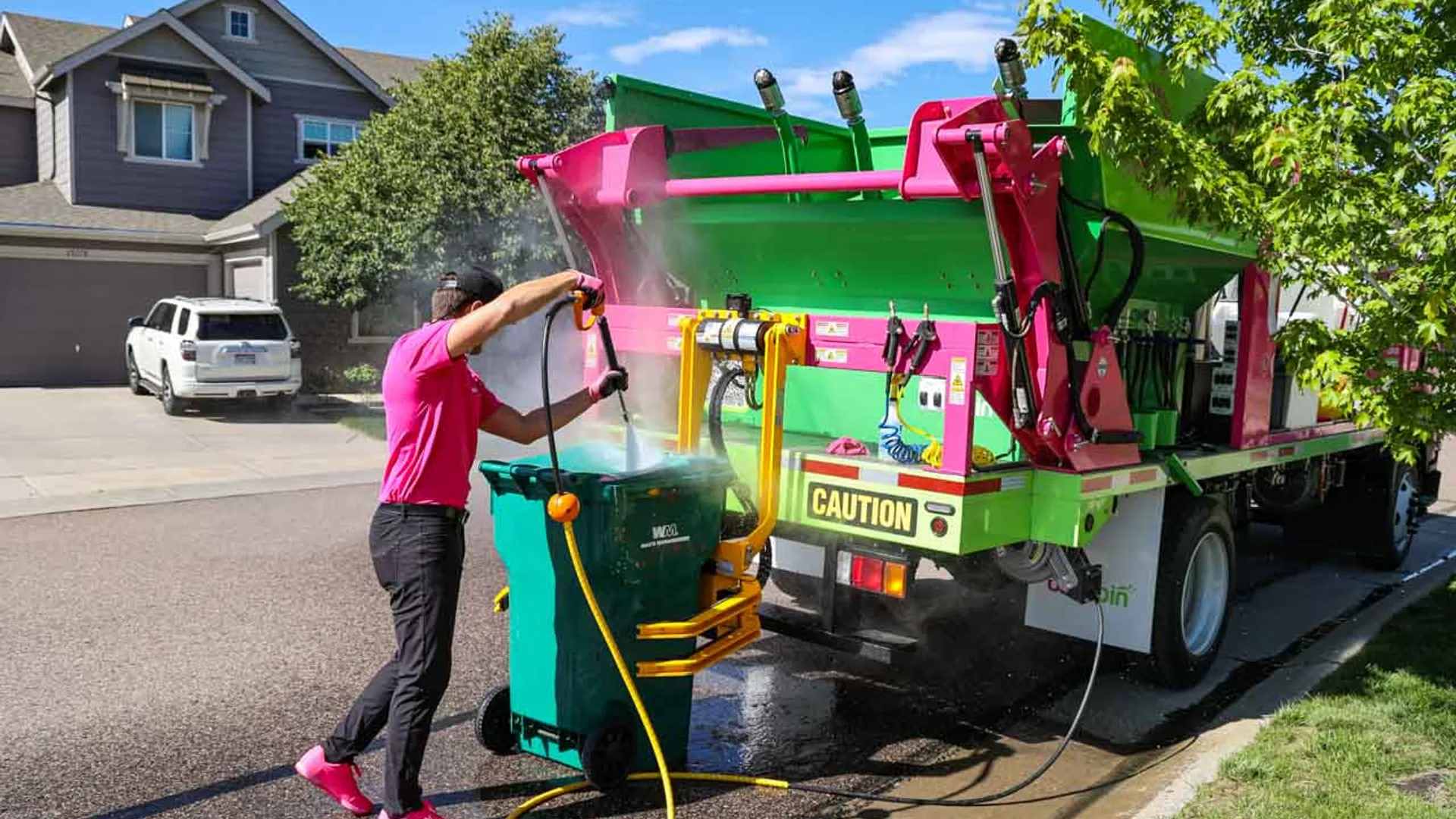
A standard curbside setup usually happens after trash pickup, when your empty bin is ready to be cleaned. The container is either lifted into a specialized cleaning truck or cleaned on site with high-pressure equipment.
“High-pressure” just means the water hits hard enough to blast off stuck residue, not just mist the surface like a garden hose. Many services also use hot water, which helps loosen grease and grime. “Sanitized” means a disinfecting solution is applied after the heavy dirt is removed, so the bin is not only cleaner-looking but cleaner in a real sense too. After that, the bin is usually deodorized and left ready to use again.
A good service should clean both the inside and outside. If only the inside gets attention, the lid and handles can still stay filthy.
Eco-friendly wastewater handling
This part matters more than it sounds. Dirty runoff from trash bins can carry grease, bacteria, old food residue, and chemicals. In Colorado, that wastewater should be captured and disposed of properly, not washed into a storm drain.
A lot of stronger local services make runoff handling a selling point, and for good reason. You should expect a clear answer about where the wastewater goes. If the answer is vague, that’s a problem.
Winter service and year-round availability
Cold weather does not make a dirty bin clean. It just makes the smell less obvious for a while.
Some Colorado companies run year-round with winterized equipment, meaning the trucks and cleaning process are set up to keep operating in lower temperatures. Freeze conditions can still affect scheduling, especially during severe cold snaps or icy access conditions. But “we pause for winter because the germs are gone” is not a serious explanation.
If year-round service matters to you, check how winter scheduling actually works in your area.
How to choose the right trash can cleaning company in colorado
A decent website is easy to build. A dependable route-based service is harder.
Questions to ask before booking
Before you schedule, get clear answers to a few practical points. Ask if the cleaning happens on trash day after pickup. Ask if any water hookup is needed from your property. Ask if the service includes both the inside and outside of the bin. Ask if there are extra fees for heavy buildup, compost, or additional containers. Ask if stuck-on debris gets handled or if the company only sprays what comes loose easily. And ask if your city or neighborhood is on a regular route, not just technically inside a giant service area map.
Those details affect convenience more than fancy branding ever will.
Signs of a solid local provider
Good providers tend to be easy to understand. Pricing is clear. Scheduling is straightforward. Service areas are spelled out instead of hidden behind a contact form. Reviews mention reliability, reminders, and bins actually coming back clean.
You also want plain answers about sanitation and runoff handling, plus some sign that the company routinely works in Colorado neighborhoods and commercial properties, not just once in a while. A route that regularly serves places like Aurora, Centennial, Parker, or Castle Rock is more reassuring than a vague statewide claim.
Red flags and common mistakes to avoid
The cheapest price is not always the best value. A bargain cleaning that skips the outside, leaves sludge in the bottom, or dumps runoff into the street is not a deal.
Another common mistake is assuming every “sanitizing” claim means the same thing. Sometimes it means a real disinfecting step. Sometimes it means the bin got wet and smelled vaguely lemony afterward. Also, if your bins get bad every month, booking repeated one-time cleanings is usually the expensive way to avoid choosing a recurring plan.
Best options by use case
The right setup gets clearer once you match the service to the mess.
Best for homeowners with standard trash and recycle bins
For a typical home, recurring curbside service is usually the sweet spot. You get predictable scheduling, easier pricing, and lower per-visit cost than one-off rescue jobs. Add-on pricing for extra bins is where the value usually shows up.
If your household only has standard trash and recycle containers and you bag waste reasonably well, every-other-month or quarterly service can be enough. But if convenience matters, monthly is hard to beat.
Best for homes with compost, diapers, or pet waste
This is where more frequent service usually pays off. Compost bins, diaper pails, and pet waste containers get foul fast, especially in summer. Waiting too long means stronger odor, more bugs, and more stubborn residue on the bottom and around the lid.
Set different expectations here. Compost often costs more and may need more frequent attention than regular trash or recycling. That’s normal.
Best for businesses, restaurants, and multifamily properties
Businesses and larger properties need a heavier-duty approach. Bigger containers, grease, shared use, and surrounding pad mess all push the job beyond standard residential pricing and scheduling.
For restaurants and multifamily properties, the container area matters almost as much as the dumpster itself. Pressure washing can be useful for the concrete pad or enclosure walls, but it should stay in the add-on category. The core service should still focus on the dumpster, the buildup, and the sanitation process.
What you can expect after booking
Once you’ve picked a service type, the process is usually pretty simple.
Before service day
For most curbside setups, prep is minimal. Leave the bins empty after pickup, make sure the lids open properly, and move cars if access is tight. If your driveway or alley is narrow, a little extra space helps the crew work faster.
That’s usually it.
After the cleaning
The main result is obvious right away: less odor, less grime, fewer bugs, and a bin you don’t avoid opening. On a warm Denver afternoon, you should be able to lift the lid without getting that full wall of smell in your face.
A clean bin also stays more manageable between visits. Small drips and crumbs are easier to deal with when the inside isn’t already coated in months of residue.
A simple way to pick your plan
If your bins are gross because of one bad stretch, start with a one-time cleaning. If the smell keeps coming back because of compost, diapers, pet waste, or heavy household use, recurring service is the better buy. And if you’re dealing with dumpsters, shared enclosures, or commercial pads, expect custom pricing and ask about add-on wash-downs.
Try one simple step: get quotes based on your actual bin count and preferred frequency, then compare what’s included, not just the starting price. That one move usually makes the right choice pretty obvious.